
Just Jules, Part One: What It Really Means to Be Human
A note from Burntwood Business
Before we begin, it feels right to tell you why this interview matters so much to us.
We first met Jules many years ago, through necessity rather than choice. A member of our team had been receiving NHS support, and that support was coming to an end. Understandably, they were worried about carrying on without it. The NHS suggested a different kind of help, something called The Big Happiness Experiment.
This is the important part. It was not something we would ever have found on our own, and not something we would have thought to look for. Without that steer from the NHS, we would never have met Jules at all.
All we can really say is that it was unlike anything our team member had experienced before. The approach was completely unique, and the lessons Jules taught are still being used to this day. In many ways, Burntwood Business grew out of that help. It gave one person the confidence to build something, and that quietly became the beginning of everything you see here.
So when it came to giving someone the spotlight, there was only ever going to be one place we wanted to start. It took us a while to pin Jules down.
But here we are.
Some conversations stay with you. This was one of them.
We have wanted to sit down with Jules Mitchell for a long time. A two-time TEDx speaker whose Big Happiness Experiment featured on Good Morning Britain, BBC Midlands Today and in The Daily Telegraph, Jules is the founder of the Mental Wealth Revolution, the creator of the SPIN Method, and the person behind the Lean Into Life community programme. More than any of that, she has a way of explaining human beings that makes you exhale and think, oh, so that is what has been going on. We talked for far longer than we planned, so we have split it into two parts. This is the first, all about who Jules is and how she sees people. Make a brew and read it slowly. It is worth it.
Jules, we always find the simplest question is the hardest one to answer. How would you introduce yourself to someone who has never met you?
That is always the question I struggle with most, because I have spent the last twenty-five years encouraging people not to define themselves by labels, and then somebody asks me to label myself.
If you wanted to, you could call me a coach, therapist, trainer, professional speaker, consultant or educator. All of those descriptions are true, but none of them really explain what I do.
At heart, I am endlessly curious about what it means to be human. I have spent the last twenty-five years studying the remarkable relationship between the brain, the body and the nervous system, while walking alongside thousands of people who believed there was something wrong with them. The greatest privilege of my life has been helping people understand themselves in a way that finally makes sense.
One of my students described that experience in a way I will never forget. She said working with me was like the moment in The Wizard of Oz when everything changes from black and white into glorious Technicolor. It was not that her life had suddenly become perfect. It was that she was seeing herself, and the world around her, through a completely different lens.
The truth is that I did not begin this journey because I wanted a career in this field. I began it because I was trying to understand myself. Everything I have created has grown from that search, from my own lived experience, from years of study and from thousands of hours spent walking alongside other human beings.
So, if you really want an introduction, I am just Jules. Another human being who is endlessly fascinated by what it means to be human, and who believes that when we finally understand ourselves, the world begins to look a little less black and white and a lot more Technicolor.
I’m just Jules.
Jules Mitchell
So who is it you really help? When you picture the people who need a Jules Mitchell in their life, who are they?
The simplest answer is human beings.
That might sound like I am avoiding the question, but I am really not. Over the years I have worked with NHS staff, senior leaders, prison officers, lawyers, doctors, teachers, therapists, farmers, business owners, parents, community groups and people who simply reached a point where life no longer felt the way they wanted it to. From the outside those lives can look completely different. Underneath, I see the same remarkable human operating system trying to navigate a world that is asking more and more of it every day.
Some of the people who find me describe themselves as anxious, burnt out, stressed or overwhelmed. Others would never use those words. In fact, they are often the people everybody else admires. They are successful, capable, dependable and the ones everyone turns to because they always seem to have another gear. Yet underneath they are overthinking, overanalysing, overperforming, overdelivering, overworking and overcaring. Their nervous system rarely gets the opportunity to slow down because, somewhere along the way, it learnt that slowing down did not feel particularly safe.
I often describe it as driving through life with your foot firmly on the accelerator. You keep going because that is what your operating system has learnt to do and, after a while, it does not even feel like a choice anymore. The trouble is that no car can be driven with your foot flat on the accelerator forever.
That is why I have come to think about the word breakdown rather differently. What if it is actually a brake-down? What if what we call a breakdown is simply the moment when the body’s remarkable operating system finally puts the brake down, because the driver simply could not?
When I really think about it, the people who find me are not defined by their profession, their diagnosis or their stage of life. They are united by something much simpler. They arrive carrying questions they have often been asking themselves for years. Why do I keep doing this? Why can’t I switch off? Why do I know what to do, but still can’t seem to do it? Very often, underneath all of those questions sits one quiet belief. There must be something wrong with me.
That is usually where I meet people. Nobody has ever explained them to themselves in a way that actually makes sense. That is where our work begins.
What if a breakdown is actually a brake-down?
Jules Mitchell
Take us right back. What did you want to be when you were younger, and how did you end up doing this?
If I am honest, I never had one of those moments where I knew exactly what I wanted to be when I grew up. I did not have a five-year plan or a carefully mapped-out career. I think, more than anything, I just wanted to be happy. I wanted to be creative, playful and free to be myself. Looking back, though, I am not sure I really knew who myself was.
The one thing I do remember being drawn towards was teaching. My mum was a primary school teacher, and I loved spending time in her classroom. There was something about helping people understand something new that always fascinated me. The irony is that formal education was not a particularly comfortable place for me. By the time everyone else was heading off to university I simply could not face another three or four years of studying. Looking back now, I can see my brain has always worked a little differently. If something captured my curiosity I could disappear into it for hours. If it did not, I struggled to engage at all.
So instead of going to university, I joined the Halifax Building Society. I ended up staying for almost twenty years. People are often surprised by that because, on the surface, financial services and what I do now could not look more different. Yet when I look back, the thread was already there. Whatever role I found myself in, I always gravitated towards developing people, training colleagues, mentoring others and helping people grow.
Those years were also the years when anxiety and depression became a huge part of my life. I experienced panic attacks, lost my confidence and spent years trying to understand why life felt so much harder than it seemed to for other people. Eventually I accepted voluntary redundancy, and although it felt frightening at the time, it also became one of the greatest opportunities I had ever been given. It created the space to begin asking different questions about my own life.
None of it was planned. I was not following a career path. I was following my curiosity. I wanted to understand people. I wanted to understand myself. Once that curiosity found its direction, everything else gradually grew from there.
You have lived a lot of what you now teach. How does your own story shape the way you work with people?
I do not think it is possible to separate my story from the way I work, because in many ways my story is the reason I work the way I do.
For more than thirty years I lived with anxiety and depression. Like so many people, I genuinely believed there was something wrong with me. I spent years trying to fight my own mind, trying to think differently, trying to become the person I thought I ought to be, without ever understanding what my brain, body and nervous system were actually trying to do.
Life also gave me a very different perspective from the other side. I have supported family members through their own struggles. My husband experienced executive burnout that left him unable to work for two years, and I became his carer during that time. My father-in-law died by suicide. Those experiences changed me. They taught me that when somebody is struggling, it is never just one person who is affected. Families carry it. Relationships carry it. Communities carry it. That is one of the reasons I am so passionate about Human Sustainability, because when we strengthen one human being, the ripple reaches far beyond that individual.
I think that is why people often tell me they feel understood when they work with me. I am not listening from the outside, trying to fit them into a model I have learnt. I am listening as another human being who has spent a lifetime asking many of the same questions they are asking now.
My story has also taught me something else that has become central to everything I do. I do not believe people need fixing. I believe they need understanding. Once we understand the remarkable operating system that has been quietly trying to protect us throughout our lives, we stop seeing ourselves as the problem and begin seeing ourselves through a completely different lens.
After twenty-five years of sitting with people, what do you believe about them that most of us miss?
One of the things I have come to believe is that every human being arrives in this world whole. We all have an innate desire to belong, to love and be loved, to connect, to contribute and to become who we are capable of becoming. I do not think we have to teach those things. I think they are already there. What life does is gradually build layer upon layer around them. Families shape us. Schools shape us. Relationships shape us. Success shapes us. Loss shapes us. Fear shapes us. Every experience teaches our remarkable operating system something about what it needs to do in order to survive, and over time those survival strategies can become so familiar that we begin mistaking them for who we are.
That is why, when somebody walks through my door, I do not immediately see the behaviour that brought them there. I do not see an anxious person, or a people pleaser, or somebody who is burnt out, overwhelmed or struggling to cope. What I see is a remarkable operating system that has adapted brilliantly to the life it has lived. I see survival doing exactly what survival is designed to do.
Perhaps that is why I do not spend much time trying to change people’s behaviours. Behaviour is one of the last things I am interested in, because behaviour is not identity. It is information. It is the visible expression of something much deeper that is happening underneath the surface. Once we begin understanding what the behaviour has been trying to achieve, it often starts making sense. And when something makes sense, we stop judging it quite so harshly.
I suppose, if I had to sum up what I believe in one sentence, it would be this. I think people spend far too much of their lives believing they are their survival patterns, when actually they are so much more than that. My work is simply about helping them rediscover the person who was there all along.
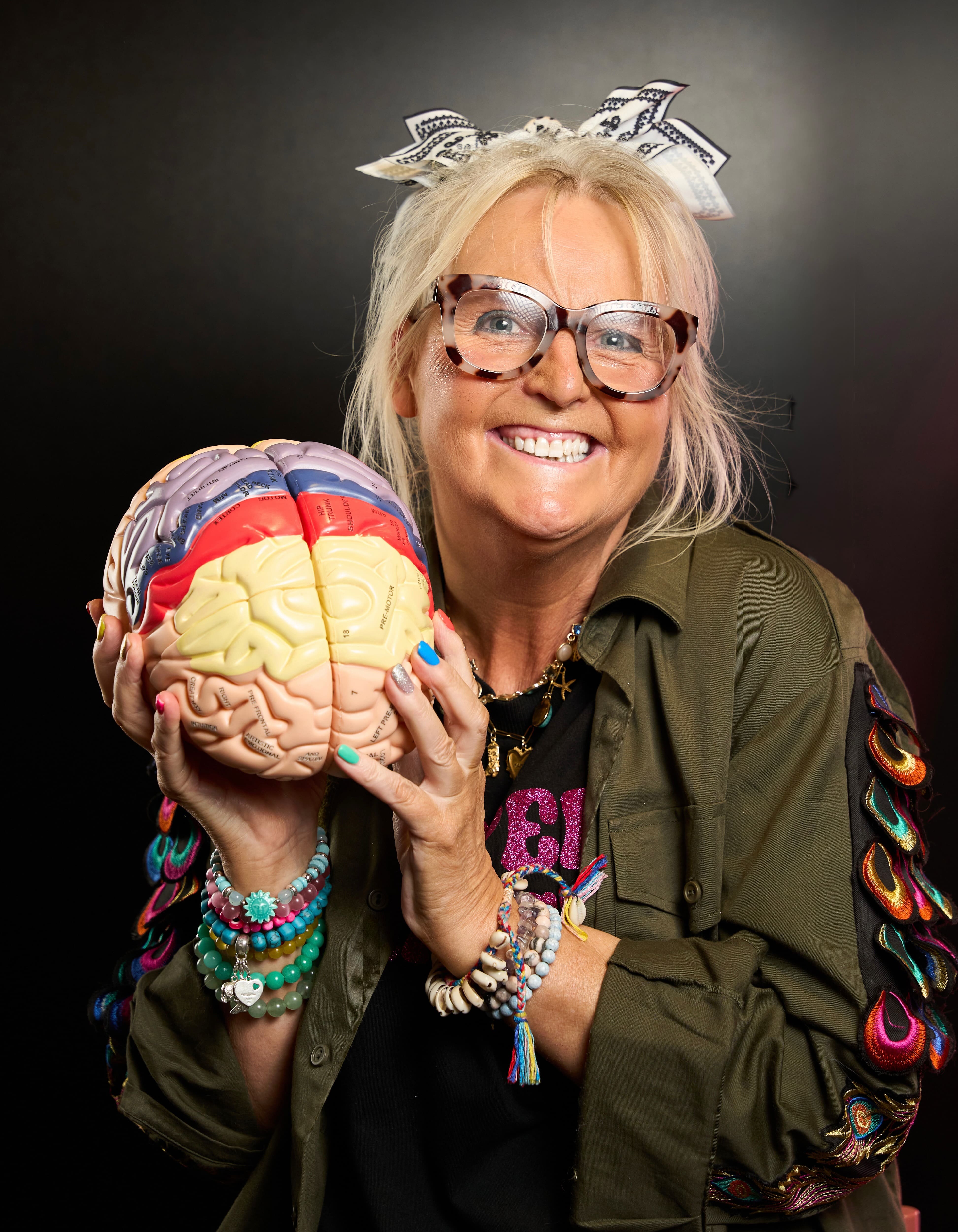
You talk about an Internal Operating System. For someone who has never heard the term, how would you explain it?
I think one of the biggest reasons so many people struggle is because we have been taught to understand ourselves through only one part of who we are. We tend to believe that everything happens in the mind, so if we could just think differently, be more disciplined or have a more positive mindset, everything else would naturally fall into place. The reality is that we are far more extraordinary than that. Human beings are not just brains walking around on legs. We are remarkable biological systems, with the brain, body and nervous system communicating with one another every second of every day, constantly asking one fundamental question. Am I safe?
Most of us instinctively understand that if our laptop starts behaving strangely, we do not blame the keyboard or shout at the screen. We know there is an operating system quietly running underneath everything else. Human beings are exactly the same. Underneath our thoughts, emotions, behaviours, habits, relationships and reactions is an extraordinary operating system that is influencing every one of them.
If your operating system senses danger, uncertainty or threat, it begins preparing you to survive. That danger might be physical, but very often it is emotional or relational. It might be criticism, rejection, uncertainty or conflict. Intellectually, you may know you are perfectly safe, yet your body is already preparing for something very different, because your brain does not speak English. It speaks biology. No wonder positive thinking, willpower and telling yourself to just calm down so often fall short. The message has never reached the operating system that is quietly running the whole show.
One of the ways I help people visualise this is through the bucket. Imagine your biological capacity as a bucket. Every demand, every responsibility, every worry, every pressure and every unresolved experience adds another drop. Most of the time we keep coping because there is still room in the bucket. Then life keeps pouring things in until, eventually, the operating system quietly says, that is enough, I need to protect you now. For one person that protection might look like anxiety. For somebody else it looks like anger, people pleasing, perfectionism, shutting down or complete exhaustion.
The good news is that buckets have taps. When we begin helping the body experience genuine safety again, pressure starts to drain away. The operating system gradually recalibrates. Thinking becomes clearer. Creativity returns. We find ourselves responding instead of reacting. And that is the moment I love most, because people stop asking what is wrong with me, and begin asking a far more useful question. What has my remarkable operating system been trying to protect me from all along?
Your brain doesn’t speak English. It speaks biology.
Jules Mitchell
This is Part One of our conversation with Jules Mitchell, founder of Mental Wealth Community CIC. In Part Two, Jules talks about what it actually feels like to work with her, why she says Mental Wealth rather than Mental Health, and the bigger change she is trying to make. You can find Jules using the link below.
If anything here resonated and you are struggling right now, you do not have to face it alone. You can call Samaritans free on 116 123, any time, day or night.